
New Dementia Treatment Research: Can Light, Sound and Ultrasound Help the Brain Clear Itself?
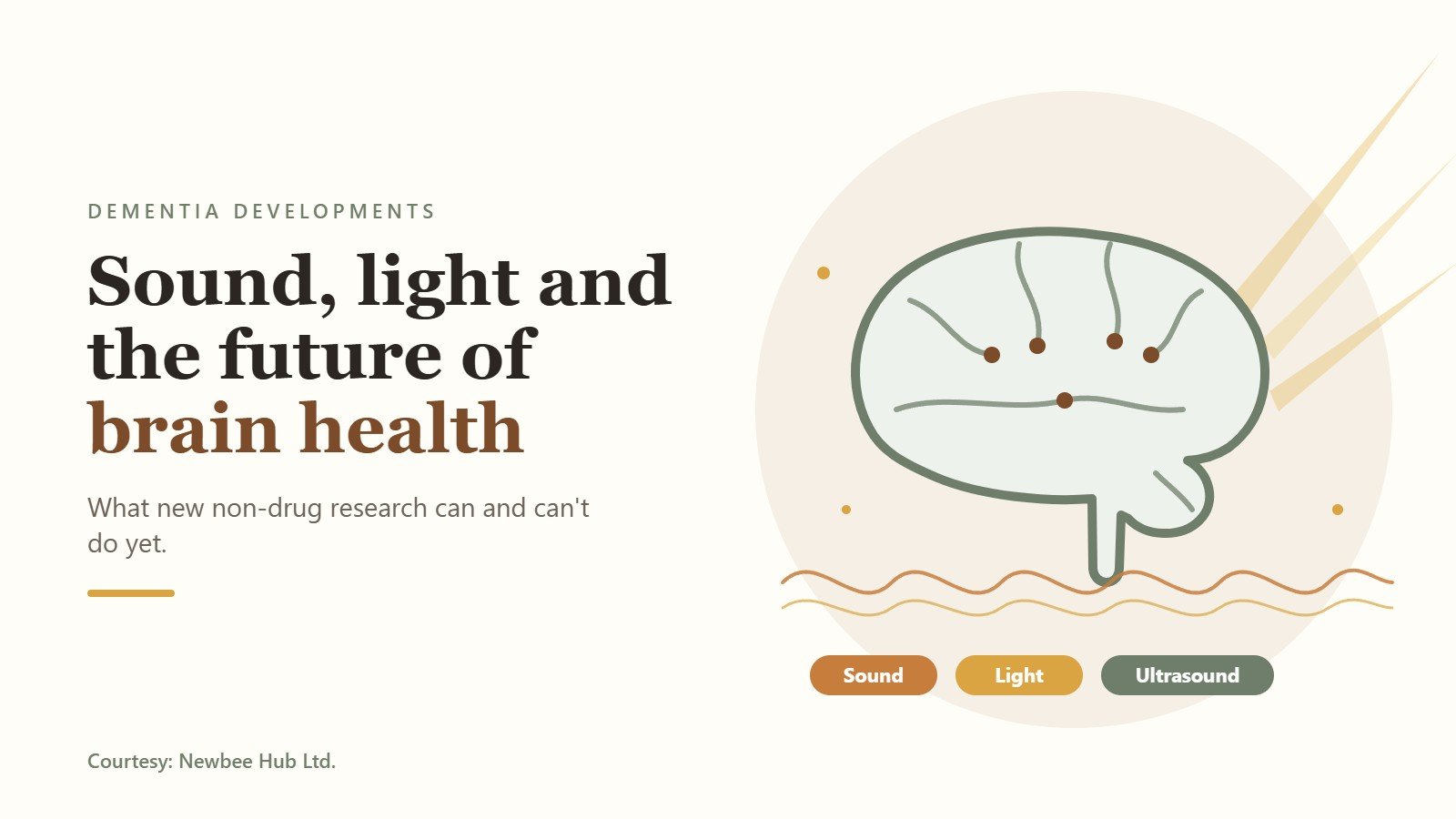
Can we help the brain clear away Alzheimer's proteins without relying only on medicines? Two non-drug approaches are being tested. Here's what we know so far, in pictures.
The brain's night-time clean-up
In Alzheimer's, proteins called amyloid and tau build up in the brain. The brain clears waste through the glymphatic system (from "glial" cells and "lymphatic"): fluid flows alongside blood vessels and washes waste away, mostly during deep sleep.
1. 40Hz light and sound
A person watches lights flicker and hears clicks 40 times a second, for about an hour a day. This boosts the brain's "gamma" rhythm, which tends to be weaker in Alzheimer's.
The evidence: In mice, 40Hz light and sound boosted the glymphatic flow and cleared more amyloid (Murdock et al., 2024). Small human studies have reported signs of slower decline. A large US trial, HOPE, has finished recruiting, but no results had been published at the time of writing.
2. Focused ultrasound
The blood-brain barrier protects the brain but also blocks most medicines. Doctors inject tiny "microbubbles" into the blood, then use MRI to aim gentle ultrasound at one spot. The bubbles vibrate and loosen the barrier for a few hours.
Why it matters
These are non-invasive, patient-friendly technologies that work with the body's own processes, and one day they might be used alongside medicines. But none is an approved dementia treatment yet. Be wary of 40Hz apps, videos or gadgets sold online, which have not been proven to work.
What we can do today
The 2024 Lancet Commission estimated that nearly half of dementia cases could, in theory, be prevented or delayed by tackling 14 risk factors (Livingston et al., 2024).
A book for families on the dementia journey
Dementia: A Way Ahead
Practical, compassionate guidance for families and carers living with dementia.
View on Amazon ↗Sources: Murdock, M.H. et al. (2024). Multisensory gamma stimulation promotes glymphatic clearance of amyloid. Nature, 627, 149–156 · Rezai, A.R. et al. (2024). Ultrasound blood–brain barrier opening and aducanumab in Alzheimer's disease. New England Journal of Medicine, 390, 55–62 · Chang, J.W. (2025). Extensive focused ultrasound blood–brain barrier opening to improve symptoms of Alzheimer's disease. Alzheimer's & Dementia, 21(S2), e103281 · Cognito Therapeutics, HOPE study (ClinicalTrials.gov NCT05637801) · Livingston, G. et al. (2024). Dementia prevention, intervention, and care: 2024 report of the Lancet standing Commission. The Lancet, 404, 572–628.
This article is for general information only and does not replace advice from a qualified health or care professional.
Image courtesy: Newbee Hub Ltd.