
Why So Many Men Struggle to Say "I'm Not Okay"
Ask a man how he is, and the most common answer is still "fine." For many men it is true. For a growing number, it is the only word they have for something they cannot yet name. Here is why the words are so hard to find, what the research says, and how a simple, screen-free activity can be a first outlet when talking feels out of reach.
What the numbers say
Around the world, men die by suicide at more than twice the rate of women, and many say they find it hard to talk about how they feel.
One caution: the global suicide rate has fallen by about 40% since 1990, though it rose in North America (Healio, reporting the Global Burden of Disease study). So "men's mental health is getting worse" is better read as what many people are seeing and feeling than as a single statistic. What stays consistent is that men are less likely to seek help, even when things are serious.
Why the words are so hard to find
For many men the problem is not unwillingness. Years of "toughing it out" leave them with little practice in naming what they feel, and each step feeds the next.
Research links two masculine norms in particular, emotional control and extreme self-reliance, to more symptoms of anxiety and depression. Part of the link runs through alexithymia, a difficulty identifying and describing emotions (Sex Roles, 2025). Earlier work found that in men this difficulty comes mainly from suppression: feelings are pushed down so consistently that the vocabulary for them fades (Levant and colleagues, 2014).
A 2025 systematic review also found that traditional masculine norms make men less willing to seek mental health support, partly because asking for help can feel like weakness. The researchers behind one of these studies suggest that support which first helps men build an emotional vocabulary, without treating masculinity itself as the problem, may work best. That is the gap a gentle, practical outlet can help fill.
An outlet can come before the conversation
For a man who has never said "I'm struggling" out loud, a counselling room or a heart-to-heart can feel like too big a first step. A smaller one is doing something with his hands and his attention. Colouring, puzzles and guided exercises have three things going for them:
- No performance: there is nothing to say and no one to impress, so the pressure to "have it together" drops.
- A break from rumination: a focused task gives a busy mind somewhere else to rest for ten minutes.
- A foothold: noticing "this calms me" or "I felt tense today" is a first step towards naming feelings.
An activity book is a gentle starting point, not a treatment. It can help a man take the edge off stress and start noticing his own state, and it works best alongside talking to someone he trusts, or a professional, when he is ready.
Where Newbee's adult activity books fit
Newbee Publication's Stress Buster Activity Book for Adults, by Richa Yadav, is built for this kind of first step. It is a 196-page book designed to ease stress, anxiety and loneliness through one calming activity per page: mandala and vintage colouring, sudoku and killer sudoku, mazes, word searches, cryptograms and zodiac doodling, with solutions at the back. No screens, no sign-ups, and nothing to explain to anyone.
When he is ready for the next step, a guided journal helps turn "I felt tense today" into words.
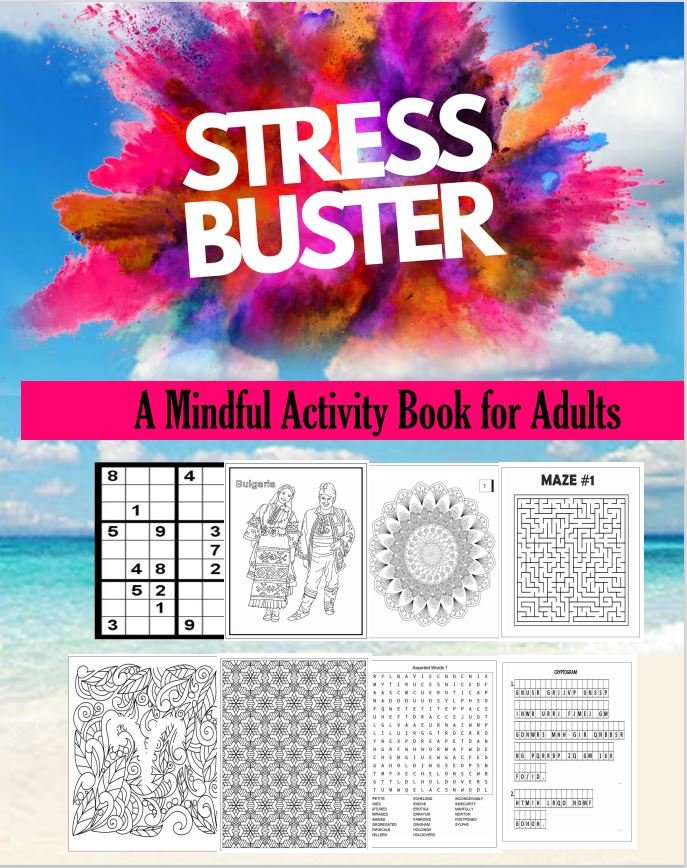
Stress Buster: Mindful Activity Book for Adults
196 pages of colouring, puzzles and doodling to unwind and give a busy mind a proper break.
View on Amazon ↗
Journal Prompts for Mental Health
Ready-made prompts to check in with your mood and put feelings into words, even if you have never journaled.
View on Amazon ↗
52 Week Mental Health Journal
A weekly check-in to name feelings, track your mood and plan small steps, one week at a time.
View on Amazon ↗If you're not okay right now
You don't have to find the perfect words. "I'm not okay" is enough. Free, confidential support is available any time:
- Ireland and UK: Samaritans, call 116 123
- Ireland: Pieta, call 1800 247 247 or text HELP to 51444 · text 50808 for Text About It
- UK: text SHOUT to 85258
- US: call or text 988
- Australia: Lifeline, call 13 11 14
If you or someone else is in immediate danger, call your local emergency number (112 or 999 in Ireland, 999 in the UK, 911 in the US, 000 in Australia).
Sources: WHO, Suicide worldwide in 2021: global health estimates (via IASP, June 2025) · Movember and Ipsos MORI, Masculinity and opening up survey (October 2019) · YouGov, International Men's Day (November 2023) · Mental Health Foundation, Men and women: statistics · Healio, Despite falling global rates, men twice as likely to die by suicide (February 2025) · Sex Roles (2025), masculine norms, alexithymia and internalising symptoms, summarised by PsyPost · Levant and colleagues (2014), alexithymia in men.
This article is for general information only and does not replace advice from a qualified health or care professional.
Image courtesy: Newbee Hub Ltd.